quarta-feira, 4 de maio de 2011

Transmissão Digital & Multiplexação


T1 é um método de transmissão digital para multiplexar canais de voz ou de dados em um par de fios. É o método padrão de interconexão de centrais telefônicas, nos Estados Unidos e Japão. Nos demais países usa-se o E1.Usando uma técnica chamada Multiplexação por Divisão do Tempo (TDM), o T1 distribui voz e/ou dados de LAN em subcanais DS0. O benefício primário do T1, é a largura de banda - 1544 Mbps - disponível em 24 subcanais DS0, facilmente alocados, de 64 Kbps. O T1 envia dados em quadros (frames), compostos de 24 palavras de 8 bits (uma palavra para cada subcanal), e um bit de framing, compondo um total de 193 bits por quadro. Um canal T1 transmite 8 000 quadros por segundo. Os bits de framing em quadros sucessivos, seguem o padrão para um formato de superquadro (superframe). O Channel Bank T1, verifica esse padrão para garantir que a sincronização seja mantida.

E1 é um padrão de linha telefônica digital europeu criado pela ITU-TS e o nome determinado pela Conferência Europeia Postal de Telecomunicação (CEPT), sendo o padrão usado no Brasil e na Europa; é o equivalente ao sistema T-carrier norte-americano, embora o sistema T norte-americano utilize taxas de transmissão diferentes.
O E1 possui uma taxa transferência de 2 Mbps (para ser exato são 2,048 Mbit/s) e pode ser dividido em 32 canais de 64 Kbps cada, contudo, 30 canais dos 32 canais existentes transportam informações úteis, pois a velocidade efetiva da transmissão (throughput) da portadora E1, é de 30 x 64 = 1920 Kbit/s, os outros 2 canais restantes (canal 0 e canal 16), destinam-se à sinalização (sistema designado por "Sinalização por Canal Comum") e o alinhamento de quadros ou tramas, estabelecendo um sincronismo entre os pontos. A contratação de linhas E1 abaixo de 2 Mbps é conhecida como "E1 fracionário".
Pode ser interconectado ao T1 para uso internacional.
Suas variantes:
  • E2: 8,448 Mbps.
  • E3: 34,368 Mbps.
  • E4: 139,264 Mbps.
  • E5: 565,148 Mbps.
  • DS3: 44,736 Mbps.

Dia Mundial do IPv6


Em Janeiro do ano corrente , a Google, Yahooo, Faceboo e Akamai Designaram o dia  24 de Junho de 2011 como sendo o dia mundial do protocolo IP versão 6 (IPv6), dia este em que os 4 gigantes da tecnologia faram os necessários testes sobre a funcionalidade e interoperabilidade do protocolo .Em Fevereiro a IANA (Internet Assigned Numbers Authority ) anunciou que as ISPs, estavam a acelerar nos pedidos dos endereços IPv4 , Devido a escassez dos endereços .

terça-feira, 3 de maio de 2011

Dia 05.CCNA Voice


identify call signaling and media stream flows

.Call signaling  types

CAS(Channel Associated signaling)CSS -Common Channel signaling

 CAS– signaling information  is transmitted using the same bandwidth as the voice.
 CSS-  Signaling information is transmitted using , separate and dedicated signaling channel.

T1 CAS signaling steals bits from the voice channel to transfer signaling information
it is often called RBS (Robbed bit signaling ).

E1 lines have 32 channels , which break-down as follows :
à E1  DSO 1  – Used for E1 framing information.
à E1  DSO 2- 16 – Dedicated use for voice (no signalling)
à E1 DSO  17 – Used for voice signaling information.

The  most popular signaling protocol used is Q.931 , which is the signaling  protocol
used for ISDN circuits .

CSS- Common channel signaling is used between voice Systesms worldwide because it offers more flexibility with signaling messages. it also allows  PBX vendors to communicate proprietary  messages , whereas CAS signaling Does  NOT.


SIP
SIP is based on the request-response paradigm. The following sequence is a simple example of a call set-up procedure:
1. To initiate a session, the caller (or User Agent Client) sends a request with the SIP URL of the called party.
2. If the client knows the location of the other party it can send the request directly to their IP address; if not, the client can send it to a locally configured SIP network server.
3. The server will attempt to resolve the called user's location and send the request to them. There are many ways it can do this, such as searching the DNS or accessing databases. Alternatively, the server may be a redirect server that may return the called user location to the calling client for it to try directly. During the course of locating a user, one SIP network server can proxy or redirect the call to additional servers until it arrives at one that definitely knows the IP address where the called user can be found.
4. Once found, the request is sent to the user and then several options arise. In the simplest case, the user's telephony client receives the request, that is, the user's phone rings. If the user takes the call, the client responds to the invitation with the designated capabilities* of the client software and a connection is established. If the user declines the call, the session can be redirected to a voice mail server or to another user.
* "Designated capabilities" refers to the functions that the user wants to invoke. The client software might support videoconferencing, for example, but the user may only want to use audio conferencing. Regardless, the user can always add functions - such as videoconferencing, white-boarding, or a third user - by issuing another invite request to other users on the link.
SIP has two additional significant features. The first is a stateful SIP server's ability to split or "fork" an incoming call so that several extensions can be rung at once. The first extension to answer takes the call. This feature is handy if a user is working between two locations (a lab and an office, for example), or where someone is ringing both a boss and their secretary.
The second significant feature is SIP's unique ability to return different media types within a single session. For example, a customer could call a travel agent, view video clips of possible holiday destinations, complete an on-line booking form and order currency - all within the same communication session.
SIP Methods
The commands that SIP uses are called methods. SIP defines the following methods:

SIP Method
Description
INVITE
Invites a user to a call
ACK
Used to facilitate reliable message exchange for INVITEs
BYE
Terminates a connection between users or declines a call
CANCEL
Terminates a request, or search, for a user
OPTIONS
Solicits information about a server's capabilities
REGISTER
Registers a user's current location
INFO
Used for mid-session signalling

SIP responses
The following are SIP responses:
*       1xx Informational (e.g. 100 Trying, 180 Ringing)
*       2xx Successful (e.g. 200 OK, 202 Accepted)
*       3xx Redirection (e.g. 302 Moved Temporarily)
*       4xx Request Failure (e.g. 404 Not Found, 482 Loop Detected)
*       5xx Server Failure (e.g. 501 Not Implemented)
*       6xx Global Failure (e.g. 603 Decline)
They closely resemble HTTP responses

Inside a SIP message

 
The Request line and header field define the nature of the call in terms of services, addresses, and protocol features. The message body is independent of the SIP protocol and can contain anything.


SCCP :
The Signalling Connection Control Part (SCCP) is a network layer  protocol that provides extended routing, flow control, segmentation, connection-orientation, and error correction facilities in Signaling System 7 telecommunications networks. SCCP relies on the services of MTP for basic routing and error detection.

SCCP messages contain parameters which describe the type of addressing used, and how the message should be routed:

  • Address Indicator
    • Subsystem indicator: The address includes a Subsystem Number
    • Point Code indicator: The address includes a Point Code
  • Global title indicator
    • No Global Title
    • Global Title includes Translation Type (TT), Numbering Plan Indiciator (NPI) and Type of Number (TON)
    • Global Title includes Translation Type only
  • Routing indicator
    • Route using Global Title only
    • Route using Point Code/Subsystem number
  • Address Indicator Coding
    • Address Indicator coded as national (the Address Indicator is treated as international if not specified)

Protocol classes

SCCP provides 5 classes of protocol to its applications:
  • Class 0: Basic connectionless.
  • Class 1: Sequenced connectionless.
  • Class 2: Basic connection-oriented.
  • Class 3: Flow control connection oriented.
  • Class 4: Error recovery and flow control connection oriented.

The cisco VoIP structure :


  • EndPoints (IP Phones, Wireless/cell Phones / Video Phone / IM Client )
  • Applications (Voice Mail  / Conference Call Apss / Call center Apps / 911 Services )
  • Call Processing ( Unified Communications Manager /Unified Communication manager Express / UC500 )
  • Infrastructure (ASA firewall  / Voice Router /Gateway / Voice Switch)

sábado, 30 de abril de 2011

Pre-historial sobre a Tecnologia VoIP


                                   Breve historial sobre tecnologia VoIP , por googleTechTalks.

quarta-feira, 27 de abril de 2011

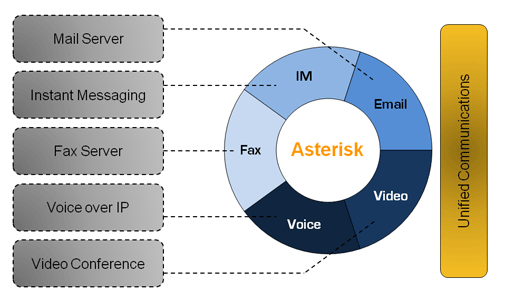
Plataforma de Comunicações unificadas- Parte 1

Elastix e um software Open source (Código aberto) sob a licença GPLv2, que estabelece um ambiente para comunicações unificadas. o objectivo primário do elastix e de incorporar todas alternativas de comunicação numa única plataforma.

O projecto começou como uma interface de relatório de chamadas da ja famosa plataforma Asterisk .lançado no ano de 2006 , um ano apos o projecto cresceu e culminou numa distribuição separada o Asterisk.

Pagina oficial de Download :  http://www.elastix.org/en/downloads.html

Conferencia Anual da (TIA) -Associação da industria de telecomunicações .


TIA (Telecomunication industry association) - Associação de industrias de telecomunicações   e   uma organização  internacional de Telecomunicações , oferecem de igual modo certificações profissionais na arena de Telecomunicações e tecnologias convergentes tais como :
 
 
  • CTP (Convergence technology professional) ,
  • CCT (Certified in converged technologies)

Organiza  a sua conferencia anual em Dallas Texas no mês de Maio..sob o lema "Inside the network"mais info no Site Oficial  : http://www.tia2011.org/

segunda-feira, 25 de abril de 2011

Dia 04.CCNA Voice

Tópico : Soluções de Comunicações unificadas da Cisco
Lição: Componentes do Sistema de comunicação unificada da Cisco.

Os componentes do CUC(cisco unified communication) solution que consta no sylabus do ICOMM sao :

1. CUCME (Cisco Unified communication Express)


àCUCM(Cisco unified Communication) :


àCisco unity Connection (CUC) :

àCisco Unified Presence.

Extra Bonus : Para complementar os videos acima, posto aqui mais um video de overview geral da suite de Comunicações  unificadas da Cisco.

Bom Proveito :) !